The old tea forest that kindles China’s ecological imagination
The Jingmai Mountain’s ancient model of growing tea inside the forest is recognized as a World Heritage and a source of sustainability wisdom.
Sunday 8th of February 2026
Upon entering the wooden house of a Blang family, one is immediately struck by the presence of enormous, dried seed pods suspended from the beams. Often as large as a child’s arm, these pods originate from a plant known in English as the St. Thomas bean. For the Blang people, an ethnic group living in the mountains of Yunnan province near the Myanmar border, the seed pods symbolize peace and safety. They are gathered from the forests just beyond the villages. However, these decorative seed pods are merely a byproduct of such excursions. Within those forests, far more significant plants demand attention: the tea bushes.
The Blang (also known as “Bulang”) people are known as some of the world’s earliest tea farmers. Nearly 2,000 years ago, as the ancestors of today’s Blang ethnic group migrated into regions now known as Yunnan, Myanmar, and Laos, they began the domestication and cultivation of tea trees. Unlike the popular image of tea plantations with meticulously arranged, well-trimmed, waist-high bushes and tender shoots carefully plucked by skilled workers, the tea bushes managed by the Blang people appear much “messier” at first glance. These bushes look and act like a part of the forest, exemplifying the Blang’s distinctive approach to tea production, a blend of nature and culture. This traditional practice serves as an inspiration for discussions on sustainable production and highlights the ecological significance of one of China’s most recent World Cultural Heritage sites.
At the end of 2025, I had the opportunity to visit Jingmai Mountain in Yunnan Province for holiday. Home to approximately 4,000 Blang people, Jingmai Mountain encompasses nearly 7,000 hectares of well-preserved old tea forests currently managed by the Blang, along with the Dai ethnic group who also reside in the area. In 2023, Jingmai Mountain was officially designated as a UNESCO World Heritage Site, marking a significant recognition of the unique tea cultivation culture of the Blang people.
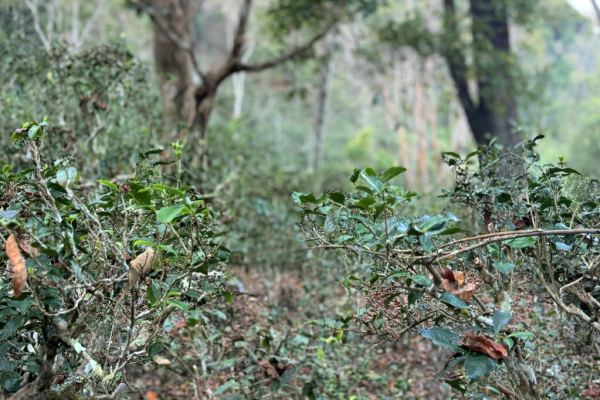
An early morning excursion into one of the mist-shrouded ancient tea forests completely upended my perceptions of tea gardens. The tea trees here are sturdy and gnarled, weathered by years of exposure to the sun, wind, insects, and birds of the subtropical forest. Every element of the environment has left its mark on these plants, from the dense foliage blanketing the ground, to the visible dents on the large, dark tea leaves left by bugs, to the scarily intricate spider webs that stretch across the branches. Most notably, the overarching canopies of banyan, Chinese guger, and Docynia trees, which often reach the height of multi-story buildings, provide essential shade. This diffused sunlight is neither too dim nor excessively scorching, creating optimal conditions for the healthy growth of the tea bushes beneath.
For millennia, the Blang people have perfected a forest-based tea cultivation system that takes advantage of what modern forestry calls “arbor-shrub-herb” stratification. The canopy layer above the tea bushes regulates shade and sunlight, while the understory helps with nutrients, humidity, and temperature regulation. The rich biodiversity of these forests also enhances natural pest management. Even during pest outbreaks, the dense vegetation between tea bushes serves as an effective barrier, limiting the spread of damage. Beyond these tangible benefits, the forest environment imparts more subtle influences. Blang tea farmers often remark that their tea leaves absorb the fragrances of neighboring plants. With a discerning palate, one might detect hints of osmanthus or even a trace of mango in a cup of their tea.
The forest’s importance to the livelihood of Blang tea farmers has fostered a spiritual reverence for trees. Within the forests, each Blang family’s patch of tea bushes contains its oldest tea tree, which is fenced off and honored as the “Tea Spirit,” the guardian of the family’s prosperity. Every spring, village elders conduct rituals before this tree, praying for a year of abundant harvest. Other vital elements contributing to the Blang community’s well-being are also respected and acknowledged. “The bees in the forest are our best friends,” Junjie, a Blang tea farmer and trader told me during my visit. The magnificent “Tree of the Bee God,” a towering banyan tree at the heart of the tea forest, adorned with more than 70 massive rock bee hives, is a powerful symbol of the Blang’s animistic beliefs, rooted in their deep connection with nature. Rock bees serve not only as crucial pollinators for the tea trees but also as natural predators of pests. For years, this sacred tree has been carefully protected to minimize disturbances to the rock bee population.
Junjie is understandably dissatisfied with the “organic tea” label now associated with the broad-leafed tea produced by the Blang people. He feels that their production methods should not be narrowly defined by eco-labels that focus solely on the use of synthetic chemicals. Much of their day-to-day practice involves meticulous interventions designed to create optimal conditions for the tea bushes. These efforts are multi-faceted: pest control is just one component, integrated with careful management of water, sunlight, and nutrients. Within the forest, osmanthus and camphor trees are intentionally preserved or planted, serving both as natural pest repellents and as sources of shade and fragrance for the tea leaves. Conversely, any water-robbing plants such as chestnuts, plantains, and bamboos are removed when identified. Weeding is performed once a year during the winter months, in accordance with the plants’ growth cycles. Blang farmers carry out this task selectively with sickles, rather than plowing, to prevent soil erosion on the mountain slopes.
In our conversation, Junjie expresses pride in his understanding of the ecological conditions on his land. In response to a minor outbreak in 2024, he handpicked more than 1,500 worms from his tea trees, and his firsthand observations corroborated the findings of a scientific study that assessed the severity of the incident. The Blang people are characteristically unfazed by pest outbreaks, viewing them as natural cycles and a form of food-sharing. Their solutions are often extremely simple: scatter some grains near the affected area and let the birds come to do the job.
A fundamental feature of the sophisticated, nature-based Blang tea cultivation model is its self-imposed limitation on expansion. The forest not only nourishes the tea trees but also serves as their natural constraint. When managed properly, this system can sustain production almost indefinitely through continuous cycles of renewal. However, it is not conducive to large-scale growth. The size of tea bushes within the forest is dictated by the capacity of the canopy above and the herb layer below to support them. Pursuing unchecked expansion can easily disrupt the delicate balance of shade, water, and nutrients essential to the health of tea bushes, ultimately leading to the collapse of the entire system.
But maintaining the old tea forest’s “steady state” has become increasingly challenging in a booming market where the large tea leaves are highly sought after worldwide. Jingmai Mountain, located on the western edge of the Pu’er tea-producing region (the “Assam of China”), faces significant pressure due to the growing demand for the tea as a commodity. This demand tempts all tea plantation owners to expand production, and the Blang and Dai communities in Jingmai are no exception. In recent years, small-scale land conversion to tea gardens has occurred along the fringe of the Jingmai Mountain forests. Locals refer to the tea produced in these areas as “tableland tea,” a reference to the intensively managed plantations established on elevated, flattened terraced fields.
Alarmed by these concerning developments, members of the Blang community advocated for restoring the converted land to forest. This initiative gained significant momentum following the 2023 World Heritage Site designation, as both local government and community leaders recognized the integrity of the ancient tea forest system as a world-class asset and national treasure. It is said that the Jingmai Mountain was prioritized for nomination among China’s many candidate sites because it perfectly embodies two predominant themes of the day: cultural assertiveness (tea as a national cultural symbol) and ecological awareness (the need to find high-profile cases of ecological civilization).
On a December afternoon in 2025, as our car snaked its way up the twisting roads of Jingmai Mountain, the glowing pink blossoms of cherry trees lining both sides were mesmerizing under the subtropical sun. I learned that many of these cherry trees had been planted after certain tableland tea plantations were cleared. Now, tourist drivers frequently pulled over along the narrow mountain path to take picture of this breathtaking scene, occasionally causing traffic jams in one of the country’s most remote corners. Will Jingmai Mountain’s commitment to ecological restraint ultimately serve as the model of high-quality sustainability that China seeks today? The answer may be found in the small packet of Blang tea I brought back from my visit: perhaps the world’s only “sour tea,” fermented underground in a hollowed bamboo tube, encapsulating the very essence of what this mountain represents.
Ecological Ideology Green Citizens

Leave a Reply