Why is China’s new air quality standard the biggest non-news in the world today?
Unfazed by strong headwinds against environmental policies across the globe, the country quietly fulfills a key promise outlined in its 2035 political blueprint.
Friday 10th of April 2026
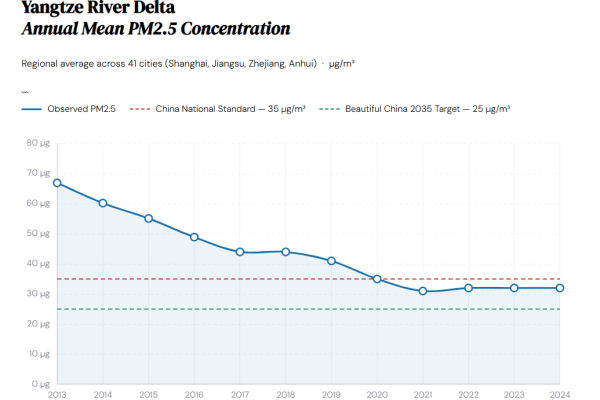
For the first time in fourteen years, China has revised its air quality standards, introducing more stringent criteria for fine particulate matter (PM2.5). According to the new guidelines, cities will only achieve Class II air quality status if their annual mean PM2.5 concentration remains below 25μg/m3, compared to the previous threshold of 35μg/m3. The implementation will follow a phased approach: between now and 2030, Chinese cities must reduce their annual mean PM2.5 levels to 30 μg/m3, with full attainment expected beginning in 2031.
China’s initial introduction of air quality standards for PM2.5 in 2012 marked a watershed moment in the nation’s environmental history. As detailed in my book (see Chapter “The Smog”), the determined effort to compel the government to regulate PM2.5, despite its initial denial of the pollutant’s role in “Airpocalypse” episodes, fundamentally reshaped China’s environmental politics. This campaign gave rise to an entirely new system of environmental governance, integrating the Party’s disciplinary mechanisms with a highly sophisticated environmental technocracy. The impact of these developments continues to be felt today.
In contrast to that pivotal moment, when global attention was focused on China’s air quality policy as a “high politics” event, the recent update has attracted significantly less international attention. Even within China, the release of the new air quality standard received minimal coverage. One explanation may be the relatively modest incremental improvements promised by the revised standards. It was groundbreaking to reduce Beijing’s annual mean PM2.5 concentration from a hazardous 90μg/m3 in 2013 to a breathable 35μg/m3 in 2021. Achieving a further reduction to 25μg/m3 over the next decade appears less remarkable, at least on paper. For the public, these improvements are hardly noticeable in daily life. Moreover, 25μg/m3 remains five times higher than the level the World Health Organization considers truly healthy.
However, it would be unwise to underestimate the significance of this revision at the present moment. From the perspective of global environmental politics, China’s progressive tightening of its air quality standards stands in stark contrast to the current trajectory of major Western countries—particularly the United States, where the EPA has voluntarily relinquished much of its authority to regulate various pollutants. The limited news coverage of this environmental initiative from China diverges on a crucial point: none of the international reports I have reviewed cite the fact that the standard update was mandated by China’s “Beautiful China 2035” agenda, which was introduced in 2023. In contrast, domestic media outlets invariably referenced this top-level policy document as the foundation for the new standards. In this important respect, the revision of the air quality standard is not entirely “news”; it represents a pre-planned milestone on China’s roadmap toward a much greener version of itself by 2035.
This divergence speaks volumes about the international community’s growing lack of sensitivity to China’s internal governance dynamics. Observers outside of China often interpret the revision as merely a public health initiative, driven by evidence linking PM2.5 exposure to mortality risks. While this perspective is not incorrect (China’s air quality standards do align closely with the World Health Organization’s guidelines as an external benchmark), it does not address the crucial question of “Why now?” within the broader context of a global “green backlash.” The Chinese public is no longer exerting significant pressure on the government regarding this issue. Unlike in 2012, when widespread public outcry compelled authorities to act, improved air quality in recent years has greatly eased that tension. China’s foreign counterparts aren’t pushing the issue either. Western nations that previously engaged China on environmental matters are so preoccupied with their own energy security and supply chain concerns that few are now prioritizing green dialogues with China—dialogues that once contributed to progressive policy shifts within the country.
The primary reason China is advancing toward stronger environmental measures at this time is its internalization of environmental improvement into the nation’s political vision. The Chinese Communist Party does not need to run traditional political campaigns or relay on “platforms”; however, throughout its more than 100-year history, it has repeatedly reinvented its de facto platform to respond to the perceived demands of the mass. Deng Xiaoping’s “Reform and Opening” initiative, launched after the Cultural Revolution, represented a new social contract with the Chinese people. Its core promise was the establishment of a modernized socialist society by the mid-21st century, measured primarily by economic indicators. Deng’s most notable vision was to quadruple China’s GDP from 1981 levels by the end of the 20th century, ushering in an era of remarkable, GDP-centered growth.
That platform has since undergone revisions by subsequent leaders. Hu Jintao introduced a “social harmony” pillar, reflecting aspirations for equity and good governance in an increasingly pluralistic society. He also initiated the incorporation of sustainable development into the Party’s agenda. This effort was picked up and ultimately completed by his successor, Xi Jinping, who introduced the concept of a “Beautiful China” into the Party platform in 2017, alongside an overarching vision of building an “Ecological Civilization.” Much like Deng’s mandate to quadruple GDP by 2000, Xi’s vision for China is also timebound. His signposts are the “Two Centenaries”: the 100th anniversary of the Party’s founding (2021) and the centenary of the People’s Republic (2049). In 2021, China announced the eradication of poverty and the achievement of a moderately prosperous society, fulfilling Deng’s longstanding goal from 1981. Now, Xi aims to set the direction and pace for the approximately 30-year journey leading up to 2049.
Improvements in environmental quality are among the most tangible and measurable aspects of this mid-century modernization project. Clean air, clear water, and healthy forests are essential components of a prosperous socialist society, marking a significant departure from the traditional “productivist” Marxist vision of modernization. These improvements serve as natural milestones along the journey. The “Beautiful China 2035” initiative, jointly released by the Party Central Committee and the State Council in 2023, provides a convenient anchor point between 2021 and 2049. A comprehensive set of quantitative targets has been established for 2035, including, most notably, the objective to reduce annual PM2.5 levels to 25μg/m³ in Chinese cities. Other targets address the post-peak trajectory of carbon emissions, the proportion of renewables in the energy mix, and the number of water bodies deemed suitable for swimming. It is reasonable to critique these indicators for lacking imagination, as they largely extend existing targets to their logical conclusion in 2035 (for instance, no substantial increase in the projected share of renewables, despite their beyond-expectation growth in recent years). Nevertheless, this remains perhaps the world’s only active 15-year environmental blueprint, as demonstrated by the recent update to the air quality standard.
A massive bottom-up social mobilization in the early 2010s contributed to the greening of the Party platform, as the leadership realized that the pursuit of economic prosperity or national power alone is no longer in sync with the people’s aspirations for a good life. However, as soon as the internalization of the environmental demand was completed, the driver for further environmental action changed.
“It would have been an utter failure on the part of the Ministry of Ecology and Environment (MEE) if it had not advanced this round of standard revision,” a close observer of air quality policy told me candidly. The Beautiful China 2035 targets have set in motion a policymaking agenda for the environmental apparatus, providing a raison d’etre for an enforcement machinery that relies on increasingly stringent environmental targets to validate its role. Since the 2013 National Air Quality Action Plan, which established attainment goals for Chinese cities based on the 35μg/m3 PM2.5 standard, significant reductions in pollution have been achieved. For example, the area around Beijing has seen a 45% decrease in PM2.5 levels from 2015 to 2024. However, progress has noticeably slowed since more than 70% of the 339 monitored cities now meet the standard, effectively removing a major incentive for further action. The most notable case is the Yangtze River Delta, including Shanghai, where the entire region achieved attainment in 2020 with an annual mean PM2.5 level of exactly 35μg/m3. Over the following five years, these cities recorded only a meager reduction of 2μg/m3. In contemporary Chinese online slang, these cities are said to be “lying flat,” facing no further regulatory pressure on this issue. A strengthened standard will likely rewind the coil spring of the clock, as over 60% of Chinese cities will fall out of attainment once the threshold is lowered to 25μg/m3.
Having a 30-year roadmap for environmental improvement does not imply that everything along the way is set in stone. In reality, considerable politicking has likely occurred regarding the new standard. The phased implementation was almost certainly a compromise to accommodate mayors concerned about the rule’s potential impact on economic performance. An earlier proposal recommended setting the PM2.5 standard at 25μg/m3 for this year, while the “Beautiful China 2035” agenda included a target of 28μg/m3 by 2027, which the new standard does not fully align with. A more glaring omission in the revised standard is the decision to leave the ground-level ozone criterion unchanged, despite calls from scientists to tighten it alongside PM2.5 due to its contribution to smog formation and its own health impacts. Nevertheless, this scientific advice was disregarded. The MEE argued that current epidemiological studies from China are insufficient to warrant a stricter standard.
The vision for the period from 2035 to 2049 is less clear, as targets become increasingly qualitative rather than quantitative. According to the blueprint, air quality in Chinese cities should reach “developed country levels” by that time. This could refer to the World Health Organization’s standard of an annual mean of 5μg/m3, or it might mean something close to 11μg/m3, which is the current air pollution level in Los Angeles. While the general trajectory is established (there is minimal political will or appetite for China’s environmental performance to regress), there remains considerable flexibility in how this path will be shaped year by year. Importantly, China has etched the environment deeply into the nation’s conception of its political future, and the recent developments in air quality standards underscore why the world should pay close attention.
Ecological Ideology Political Economy
Excellent as always by one of the best and keenest observers of Green China. Congratulations!