China’s shared bikes are quietly delivering results when no one is watching
Having reemerged from a turbulent collapse, the revolutionary dockless bike-sharing industry is finally nearing the realization of its sustainability promise.
Wednesday 8th of October 2025
“Bike graveyards,” unpaid deposits, and chaotic streets—these were the global headlines a few years ago when China’s brightly colored, mobile phone-activated, dockless shared bikes appeared in major cities by the millions, rapidly transforming urban transportation overnight. Companies such as Mobike and OFO, part tech start-up and part public service provider, quickly became national sensations. Supporters hailed them as innovators in the burgeoning “sharing economy,” grouping them with companies like Uber and Airbnb. Critics, however, saw them as irresponsible disruptors that further cluttered already disorderly city streets, making sidewalks nearly impassable and metro station exits congested. Additionally, some of these companies were revealed to be financial frauds, siphoning massive deposits from consumers to fund questionable capital maneuvers.
Amid this heated public discussion, the environmental merits of shared bikes remain a debatable topic. Bikes that are readily accessible throughout city streets, easy to rent, and easy to return are intended to encourage people to choose them over taxis or Chinese-style tuk-tuks for short trips not covered by other forms of public transportation. Initial research appears to confirm this intuitive observation. However, if the full life cycle emissions are considered, the picture becomes more complicated. The production of millions of new shared bikes requires substantial amounts of metals and plastics, resulting in significant emissions. When discarded, these bikes contribute to large piles of solid waste. Even during daily usage—which is supposed to be emissions-free—the bikes often require manual transportation across the city to ensure optimal distribution, preventing overcrowding in some areas and shortages at key locations such as popular metro stations. Much of this manual redistribution is currently carried out using platform trailers powered by fossil fuels.
In other words, the life-cycle environmental impact of shared bikes is not a foregone conclusion simply because they are bikes and are often labeled as “green transportation.” Instead, it largely depends on how the bike-sharing companies manage their fleets. This is where the business model becomes crucial. A model that focuses on fleet expansion and new user recruitment—generating a massive influx of cheap cash deposits for companies—will accelerate the production phase of the life cycle and increase pressure on end-of-life bike handling. This is precisely what happened around 2016, when early start-ups competed for market share by flooding city streets with millions of bikes and subsidizing usage to attract new sign-ups. That business model ultimately collapsed as investors abandoned the overextended companies and consumers demanded their deposits back en masse, similar to a bank run. The bankruptcy of leading firms such as OFO was scandalous from a business perspective, as national media uncovered serious misuse of deposit funds by its management. It was also scandalous from an environmental standpoint, as an enormous number of barely used bikes entered the waste stream due to lack of ownership and maintenance.
The spectacular implosion of China’s earlier champions in the shared bike industry around 2019—Mobike was acquired by Meituan and ceased operations shortly thereafter—marked the sector’s last “global moment.” At the time, international media coverage was characterized by lamentation and mockery. The massive piles of waste left behind by Ofo and others became the physical manifestation of the violent boom-and-bust cycle of China’s celebrated mobile internet innovations. Since then, global attention on China’s shared bikes has virtually disappeared. Outlets have largely stopped reporting on the issue, as if it has ceased to be relevant and is simply another burst bubble.
As an almost daily user of shared bikes in Beijing today, I can attest that the opposite is true. In fact, the reshuffling of the industry following its collapse and the resulting public backlash has put pressure on both the industry and city administrators to pursue a more sustainable path for the business. They have few external models to follow. Unlike earlier public transportation innovations, such as Bus Rapid Transit (BRT), for which China actively sought input from international experts, dockless shared bikes are truly unique inventions. No other country can teach Chinese cities how to implement them correctly.
Chinese city governments were the first to impose sustainability requirements on shared bikes. In 2021, Beijing set a cap on the total number of shared bikes allowed on its streets: 800,000—a 60% reduction from the peak fleet size of 2.35 million in 2017. Other cities quickly followed suit. This upper limit ended the era of incessant industry expansion, especially for newcomers whose initial strategy was to flood the market with new bikes to attract users. This regulatory barrier to market entry incentivizes existing operators to shift their focus from protecting market share to pursuing long-term objectives, such as enhancing user experience and improving the durability of their bike assets. The latter is particularly important for realizing the industry’s environmental potential. By ensuring that each bike is used long enough to generate more cash flow for the company, operators can reduce the need for new production (a major source of emissions), prevent waste disposal, and deliver greater emissions reductions.
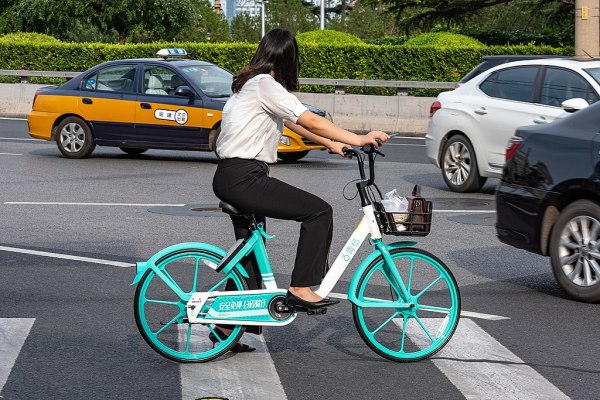
Following the establishment of this “new normal” in major cities, operators visibly changed their behavior. New designs were introduced to increase the durability of bikes, and a new generation of sturdy, easy-to-ride models gradually replaced the flimsier ones from the early era. One notable improvement is the locks: traditional mechanical locks, which were most susceptible to damage and malfunction, have been replaced by internal wheel locks that are invisible to users. A more fundamental change—affecting both the bikes and city infrastructure—is the integration of GPS tracking and electronic fencing systems, which have revolutionized fleet management. The chaotic scenes of the early days of bike sharing were largely caused by inappropriate parking behaviors among users. Electronic fencing essentially brings the “dock” back to the dockless model, without the physical burden of installing metal racks throughout the city. By using GPS tracking in combination with street-level buttons that utilize Bluetooth signals to determine bike proximity, operators can now regulate parking locations with unprecedented precision. Parking outside designated zones is much more difficult today, as the invisible locks will refuse to engage and users will continue to be charged until they move their bikes inside the approved zones.
From an environmental perspective, technology-enabled parking regulation allows operators to optimize fleet distribution throughout cities, reducing the need to manually relocate bikes using vehicles—a significant source of emissions. It also facilitates the retrieval of bikes back into the system, preventing the abandonment of bikes in distant locations and thereby minimizing waste.
The set of technical and regulatory changes has significantly shifted the bike-sharing business model, as reflected in the statistics reported by major operators. For instance, Meituan—one of the three leading bike-sharing companies in China today—reports that its bicycles reach a carbon break-even point at 594.66 kilometers of mileage. Meanwhile, the average Meituan bike achieves a lifespan mileage of 4,982.8 kilometers, resulting in carbon reduction for more than 88% of its life span. This improvement is attributed to several factors: better replacement of other transportation methods, reduced need for manual redistribution, and a higher rate of end-of-life recycling of raw materials, made possible by GPS-enabled tracking of each bike.
While the environmental benefits of shared bikes are finally beginning to materialize following the end of unchecked expansion, the economics of the new model remain unresolved. All major bike operating companies in China have reported significant losses over the past few years, subsidizing this line of business with revenue from other departments, such as food delivery. With the substantial influx of new deposits depleted, the only remaining revenue stream—rental charges, which can be as low as 1.5 yuan per half an hour (approximately $0.20 USD)—is insufficient to cover the costs of managing and maintaining a still sizable fleet. Although operators have implemented multiple fee increases (Meituan has reported steadily rising per-bike revenue), there is also the risk of losing customers if riding a shared bike becomes too costly. The triangular challenge of maintaining a stable fleet with capped growth, serving a clientele sensitive to price hikes, and operating a for-profit business under heavy sustainability regulations seems nearly impossible to resolve. For operators like Meituan, what keeps shared bikes running appears to be the valuable user data that can be leveraged for other business opportunities.
Once again, China appears to have discovered a technology-driven approach to enforcing sustainability in an emerging industry, much like it addressed air pollution through strong state control supported by advanced monitoring and modeling techniques. This time, internet tech giants are being compelled to innovate in order to survive within a heavily regulated business environment. The ultimate outcome for China’s revolutionary dockless bikes remains unclear, however, as sustainability comes with significant costs. Until the expense of providing a sustainable business service can be shared equitably among operators, regulators, and consumers, the future of China’s bustling city streets will continue to face uncertainty. The real question is whether the politics of Chinese urban management allow room for a negotiated, long-term solution.
Political Economy

An excellent piece. Very interesting insights about what really is an giant experiment for a unstable business model.