Premier Zhu Rongji’s environmental legacy
The man known for his bold economic reforms in the late 1990s has left an undervalued mark in China’s environmental history too
Friday 25th of September 2026
On Aug 12, 2026, Mr. Zhu Rongji passed away at the age of 98. He was China’s premier from 1998 to 2003. Though he served for only one term, he is widely regarded as a highly consequential head of the government for the People’s Republic. In fact, Prof. Hu Angang of Tsinghua University, an influential government advisor, ranked him as China’s most capable macroeconomic manager and stabilizer since Zhou Enlai. (The Aug 22 article on WeChat was later set unviewable publicly.)
Zhu’s name is associated with many landmark reforms that have significantly shaped China’s development trajectory since his tenure: the dissolution of State Owned Enterprises (SOEs), the commercialization of residential housing, the reallocation of tax revenues between the Center and the provinces, and most importantly, the accession of China to the World Trade Organization(WTO). The reforms, especially the last item, ushered in an era of ultra-fast economic growth and deep integration of the Chinese economy with the global market.
His list of achievements is so extensive (some of them are admittedly controversial, such as the mass layoff of SOE employees) that the one environmental legacy does not even enter the usual obituary in Chinese mass media. But people who are concerned with China’s ecological future commemorate him for his decisive 1998 logging ban that kicked started three decades of Natural Forest Protection Program. In retrospect, Zhu’s NFPP might be one of the most consequential environmental interventions that a single country has made, with its repercussions still felt around the world today.
Although estimates vary, it is safe to say that by the end of the 2020s, China’s NFPP had placed under protection a swath of forest roughly the size of Peru and, through numerous afforestation initiatives, had created an additional 13 million hectares of forest. According to some research, the 180-degree reversal in the fortunes of China’s living forests has been one of the greatest contributors to the global expansion of leaf areas over the past two decades. The reclamation of deserts by vegetation in western China is a vivid demonstration of the political will to re-green the country.
The impressive outcomes of the NFPP today can easily obscure just how severe forest degradation was when Zhu Rongji put the brakes on commercial logging in 1998. The devastation caused by that summer’s floods in the Yangtze, Sangari and Nen River basins shocked the nation to its core. More than 4,000 people were killed, and millions were affected. In major riverside cities such as Wuhan, the collective effort to hold back the water with human walls was almost warlike. What made the toll especially tragic was that extreme weather was only partly responsible for the severity of the flooding. Zhu Rongji himself recalled that runoff in the Yangtze was not at its highest that summer, yet water levels somehow reached an all-time high because soil erosion upstream had caused sedimentation. Before 1998, astronomical amounts of silt entered waterways each year as a direct result of vegetation degradation along the rivers. Forest loss further reduced the water-retention capacity of watersheds.
Commercial logging peaked in 1997, as China’s rapid growth following economic liberalization in the early 1990s drove up demand for timber for uses ranging from infrastructure development to housing construction. Much of this logging took place in pristine old-growth forests in the mountainous headwaters of major rivers such as the Yangtze, where centuries-old spruce trees were reduced to meter-wide logs in mere minutes. Chinese reportage and literature from that period described the sounds of chainsaws and loggers’ shouts reverberating like ghosts through the primeval depths of the forests. One of the most influential works of environmental nonfiction of the 1980s was Xu Gang’s Woodcutters, Wake Up! In this long-form article, published in 1987, Xu documented the mind-boggling scale of logging across the country, which denuded some of China’s most iconic mountaintops, once known for their thousand-year-old pine trees.
Xu’s account demonstrates that the link between massive deforestation, soil erosion, and flooding had already been etched into the national consciousness by the 1980s. In 1976, the collapse of the Banqiao and Shimantan dams on the Yellow River raised early alarms about the extent of sedimentation in the watershed and its tragic consequences. “The river was not just flowing; it was bleeding,” Xu wrote. By the time he was writing his seminal piece, the rallying cry had become, “Don’t let the Yangtze become a second Yellow River,” whose name derives from the muddy appearance of its water. The Yangtze, once clear and translucent, was carrying a staggering 530 million tons of sediment from its source to the sea annually in the 1980s.
Concerns about the effects of deforestation-driven erosion on hydrological infrastructure and navigation along the Yangtze already carried a sense of urgency. A 1985 compilation of data from eight upstream provinces showed that a total area of 350,000 square kilometers was affected by soil erosion, accounting for more than one-third of the provinces’ combined land area. In some counties, “farm land can turn into bare rocks in a matter of one year, leading to involuntary migrations,” the memo stated. “The situation is worse than along the Yellow River.”
However, once the chainsaws started, they were hard to stop. Xu’s piece depicted a wave of logging across the country that can best be described as a frenzy. The scene was particularly disturbing because, in 1987, shortly before the publication of Woodcutters, Wake Up!, a devastating fire in the Great Khingan Range burned more than 1.3 million hectares of coniferous forest and killed nearly 200 people. The disaster was supposed to be a wake-up call about forest stewardship, as systematic negligence by forestry management bureaus was blamed for the fire. Yet its lessons were quickly forgotten in the years that followed, as cashing in on timber proved to be a quick and dirty way to “get rich fast,” the motto of the Reform and Opening era. Entire villages became involved in illegal logging, stripping mountains that their ancestors had safeguarded. Forestry bureaus and state-owned forestry enterprises that were supposed to enforce logging quotas became accomplices, sometimes even ringleaders of tree-felling operations.
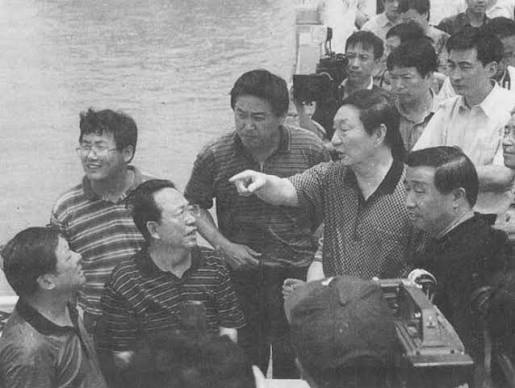
In 1996, then–Vice Premier Zhu Rongji witnessed firsthand the scale of deforestation in Sichuan Province, along the upper reaches of the Yangtze. During an inspection of Panzhihua, he saw logs rolling down the mountains into the river (a standard method of transporting them) causing congestion on the waterway. That striking scene reportedly strengthened his resolve to “invite the logging tigers down from the mountains.”
While Zhu is credited with the decisive 1998 logging ban covering the upper reaches of the Yangtze, Yellow, and part of Inner Mongolia, small-scale logging bans were already in place in areas where deforestation had been particularly severe. In the Qilian Mountains, for instance, the local government implemented a 10-year logging ban in 1980 in response to rampant destruction that threatened the livelihoods of four million people who depended on the vulnerable snow-capped mountain ecosystem. Zhu’s logging ban was more comprehensive by design, as it incorporated both a stick (the ban) and a carrot (the subsidy package). If SOE reform was a signature feature of Zhu’s tenure, then forestry SOEs, once a source of strategic materials for the state, became natural targets for reform. Logging enterprises in areas covered by the ban were transformed into forest-management organizations, with much smaller staffs serving as forest patrols. Laid-off workers were offered either market-based contracts for forest management or retirement buyouts. Zhu’s central government bore most of the financial cost, while provincial governments were asked to cover the remainder. Another component of the package was the Grain-for-Green initiative, which paid farmers to convert farmland back into forests or pastures. The initiative took advantage of China’s large grain surpluses in the late 1990s, using them as a strategic opportunity to rehabilitate forests; in some regions, farmers were paid directly in grain rather than cash. In many respects, Grain-for-Green has been one of the most powerful drivers of reforestation in the country.
The 1998 logging ban and its ancillary measures were later consolidated into the NFPP. In terms of scale, only Brazil’s program to control deforestation in the Legal Amazon is comparable. Thailand, China’s neighbor to the south, implemented a similar logging ban a decade earlier, also in response to deadly flooding. Nevertheless, Zhu’s initiative left a mark on the country’s environmental history that extends beyond forestry. While many trace China’s current concept of Ecological Civilization to the evolution of President Xi Jinping’s green thinking or to environmental pioneers such as Pan Yue (as I did in my book), Zhu’s articulation of the NFPP represents an undervalued early source of top-level environmental discourse. Years before Xi and Pan assumed truly consequential positions in the CCP, Zhu, as premier, elevated ecological restoration to a generational commitment. In a 1999 speech championing the program, he described the effort as producing “results before our eyes, with benefits felt by our grandchildren” (收效当前,泽被子孙). He also linked forest recovery to the restoration of soil productivity, a foundation for the nation’s long-term food security.
In fact, a key component of Xi’s Ecological Civilization agenda builds directly on Zhu’s legacy. In 2014, a year into his presidency, Xi announced his intention to expand the scope of the NFPP with the goal of “bringing all natural forests under protection,” suggesting that the program should go beyond the upstream areas of major rivers and key protected areas. In 2017, a sweeping logging ban across the country was in place, after two years of pilots following Xi’s statement. Commercial logging became history in China, completing a policy chapter that Zhu started.
It is worth mentioning that Zhu Rongji’s initial logging ban targeting the upper Yangtze region would not have been as effective without the intervention of the Chinese media and concerned citizens. The 1998 Yangtze floods had barely receded before Friends of Nature volunteers in Sichuan received a tip that one of the counties in the upper Yangtze province was carved out of the logging ban and cashing in on a market thirsty for timber that had suddenly become harder to obtain. The volunteers, led by Wu Dengming, who would later become a leading figure in the environmental movement, teamed up with reporters from China Central Television (CCTV) to obtain undercover footage of rampant logging in the remaining forests of western Sichuan. They did so at great personal risk, facing the threat of being intercepted and beaten by thugs hired by logging bosses and local government officials. The process of smuggling the videotapes out of the county resembled a spy movie, involving decoy cars and a female reporter disguised as a man.
When the program aired on primetime national TV, it alarmed Zhu so much about the loopholes in his logging ban that he personally inspected Sichuan several times and saw to it that the county chief was punished. He later praised the CCTV team for their courage in revealing the truth to central leadership. His willingness to partner with the media remains a defining hallmark of his political leadership.
While the NFPP is impressive on the domestic conservation front, its implications for forests in other parts of the world are less encouraging. The turnaround in logging activities inside China was immediate. Domestic timber production registered a steep 31.6% drop from 1997 levels in 2002. However, there is a mirror image in China’s import of timber products, which climbed rapidly as domestic forests became off-limits (the growth rate was a whopping 97.8% for 1999).
This shift was almost by design. Another key piece of policy that Zhu’s central government pushed around the same period was a set of financial incentives for importing timber products from elsewhere. These included lowering tariffs on such products and loosening licensing rules for importing enterprises. In many ways, this aligned with Zhu’s general agenda of trade liberalization. China’s WTO accession under his leadership also put downward pressure on tariffs in general, easing the entry of wood products from Russia, Southeast Asia, and Africa to feed a construction boom that lasted for over two decades after the late Premier’s tenure.
Today, the world is still grappling with the mixed consequences of China’s NFPP, which in retrospect might have been too nationalistic in design. Were we asking for too much foresight from a man who had to deal with the myriad challenges facing China around the turn of the century? Perhaps. After all, Zhu Rongji embodied a China that placed profound faith in a global system—one it believed should have the capacity to accommodate the entry of a rising power. That is why it is the responsibility of the living generation, equipped with the hindsight and know-how of the 21st century, to get Zhu’s environmental legacy right.
Ecological Ideology Elite Politics Green Citizens
Leave a Reply